Spotlight Series
Stay updated with insights from Adial’s executives on the latest company news and key developments in addiction research.
View All Spotlight SeriesDamp January: Rethinking How Progress Is Defined in Alcohol Use Disorder
January 28, 2026
Moving beyond all-or-nothing: defining progress through fewer risks, not perfection.
Each January, Dry January reenters the public conversation as a widely recognized opportunity to reset drinking habits following the holidays. For some individuals, a period of abstinence provides clarity, structure, and a meaningful pause from alcohol use. For many others, however, the goal is not complete cessation. Instead, it is to reduce drinking in a way that is achievable, sustainable, and aligned with their lives. This distinction reflects a broader shift in how alcohol-related change is increasingly understood, and it aligns with the World Health Organization’s “risk drinking level” framework, which recognizes step-down reductions as meaningful progress[1].
This evolving perspective has contributed to growing interest in Damp January, a cut-back approach that asks people to set personal limits (for example, alcohol-free days or a weekly drink cap), track intake, and swap in low- or no-alcohol options rather than eliminating alcohol entirely. Damp January emphasizes fewer drinks, fewer heavy drinking days, and greater awareness of drinking patterns. These goals align with evidence showing that reducing heavy-drinking days, even without full abstinence, is associated with meaningful improvements in alcohol-related outcomes. A study published in the Journal of General Internal Medicine found that reducing drinking even without full abstinence was linked to better health and day-to-day functioning for up to three years, underscoring that progress need not be defined solely by complete cessation[2].
Why Abstinence-Only Resolutions Do Not Work for Everyone
Abstinence remains an appropriate and effective goal for some individuals, particularly those with more severe forms of Alcohol Use Disorder. According to the National Institute on Alcohol Abuse and Alcoholism (NIAAA), when AUD develops, brain changes make it hard to control or stop drinking even with strong motivation, and many people need support to succeed[3]. At the same time, chronic heavy drinking impairs stress regulation, decision-making, and self-control, which helps explain why abstinence-based resolutions can be difficult to sustain.
Stigma also plays a meaningful role. Declaring sobriety can prompt judgment, misunderstanding, or unwanted assumptions, which may discourage individuals from engaging openly in behavior change. When abstinence-based resolutions are not maintained, this outcome is often interpreted as a personal failure rather than a reflection of how alcohol affects the brain and stress response. The American Addiction Centers note that abruptly stopping alcohol use, often referred to as quitting cold turkey, can be both physically and psychologically challenging, particularly for individuals with established dependence, reinforcing that sustaining abstinence is not simply a matter of willpower.[4]
Damp January and the Role of Harm Reduction
Damp January aligns closely with the principles of harm reduction, which prioritize reducing risk and negative health consequences while supporting incremental and sustainable change. Rather than requiring immediate abstinence, harm reduction recognizes that meaningful progress can occur through reduced alcohol consumption and improved control. According to the National Institute on Alcohol Abuse and Alcoholism, harm reduction approaches in Alcohol Use Disorder treatment have been associated with fewer drinking-related consequences and measurable improvements in mental health, blood pressure, and liver function.[5]
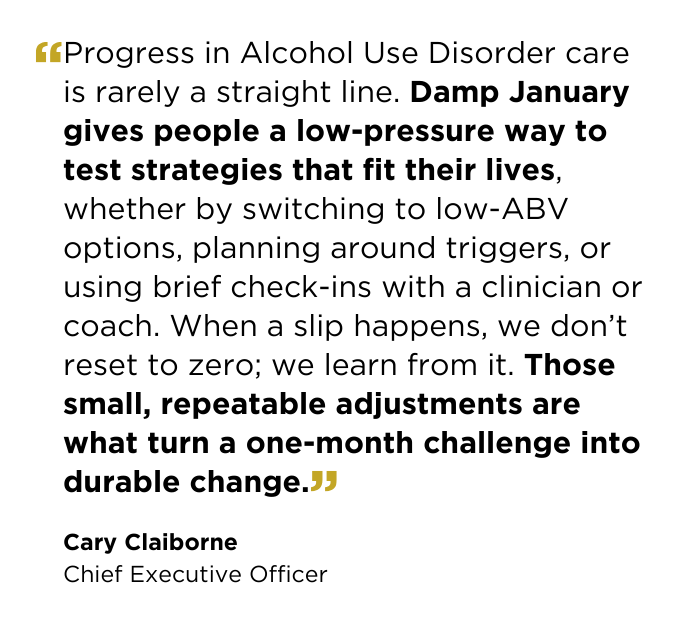 Clinical perspectives on recovery have evolved alongside this evidence. NIAAA’s Core Resource on Alcohol notes that reducing or quitting drinking can help address health issues and symptoms, including hypertension, liver problems, trouble sleeping, anxiety, and depression, supporting quality-of-life gains as alcohol use declines.[6] These outcomes are increasingly recognized as valid indicators of progress in clinical care. Harm reduction does not replace abstinence as a goal for those who need it. Instead, it broadens the framework for recovery to include pathways that more individuals are willing and able to pursue.
From Damp January to Ongoing Care
For many individuals, Damp January represents a starting point rather than an endpoint, because reduction-focused approaches like Damp January can help people reassess their relationship with alcohol without the pressure of committing to permanent abstinence. Sustainable change often unfolds over time and may require clinical guidance, evidence-based tools, and compassionate care that recognizes setbacks as a common part of the recovery process rather than a sign of failure.
One of our goals at Adial Pharmaceuticals has always been to align with efforts to modernize Alcohol Use Disorder care. By integrating scientific insight, personalization, and harm-reduction principles, this approach reflects how many people engage with behavior change in the real world.
Our work also focuses on advancing precision medicine approaches for Alcohol Use Disorder. This reflects growing evidence that treatment response in AUD varies by underlying biology, including genetic factors that influence drinking behavior and how individuals respond to different interventions. Precision medicine seeks to use these insights to better match people to care pathways that fit their biology and goals, including reduction-focused approaches when appropriate. This perspective aligns with reduction-focused frameworks like Damp January by meeting individuals where they are and supporting realistic, patient-centered goals.
Precision, Compassion, and the Path Forward
Progress in recovery does not need to be defined by perfection. It can be reflected in reduced harm, improved control, and greater awareness of health and behavior. Damp January represents a valid and meaningful approach for individuals seeking change, one that aligns with evolving science and patient-centered care. In practice, that can mean fewer heavy-drinking days, lower weekly intake, more alcohol-free days, and improved sleep and mood. As precision medicine and harm reduction continue to advance together, they offer the potential to broaden access to effective treatment and redefine what recovery can look like throughout the year, meeting people where they are and helping them build sustainable habits.
[1] Alcohol: Clinical and Experimental Research, “Reductions in WHO risk drinking levels correlate with alcohol craving among individuals with alcohol use disorder” January 2024
[2] Journal of General Internal Medicine, “Stability of Drinking Reductions and Long-term Functioning Among Patients with Alcohol Use Disorder” November 2020
[3] National Institute on Alcohol Abuse and Alcoholism — Core Resource on Alcohol, “Stigma: Overcoming a Pervasive Barrier to Optimal Care,” May 2025
[4] American Addiction Centers, “Can You Die From Drug or Alcohol Withdrawals?” April 2025
[5] National Institute on Alcohol Abuse and Alcoholism — Core Resource on Alcohol, “Neuroscience: The Brain in Addiction and Recovery,” May 2025
[6] National Institute on Alcohol Abuse and Alcoholism — Core Resource on Alcohol, “Stigma: Overcoming a Pervasive Barrier to Optimal Care,” May 2025