Spotlight Series
Stay updated with insights from Adial’s executives on the latest company news and key developments in addiction research.
View All Spotlight SeriesWhen Policy Finally Catches Up to the Science on Alcohol Addiction
March 27, 2026
Inside Congress’s recent directive to the FDA on AUD and the Administration’s push for modern, patient-centered alcohol treatments
For decades, American families have suffered under the weight of alcohol addiction. Alcohol Use Disorder (AUD), defined as the inability to stop or control alcohol use despite negative consequences, affects a staggering number of Americans. Excessive alcohol use takes roughly 500 American lives every day, and AUD impacts nearly 1 in 10 Americans each year[1]. Yet despite this enormous burden, fewer than 1 in 10 Americans with AUD receive any form of treatment, leaving tens of millions without care[2]. For too long, this silent epidemic failed to receive the national attention it deserves.
America’s veterans are particularly vulnerable, with as many as 9% of U.S. military veterans meeting criteria for AUD[3], reflecting a serious health crisis among those who have served our country. Women are also facing a quiet but accelerating crisis, with alcohol-related deaths and hospitalizations climbing more rapidly for women than for men in recent years[4]. These figures underscore the immense scope of the AUD problem. The economic toll is staggering as well: the last comprehensive analysis pegged the cost of alcohol misuse at $249 billion in 2010[5], which would be far higher today.
As the CEO of Adial Pharmaceuticals, I am heartened by new bipartisan efforts in Congress and the Trump Administration’s resolve to curb alcohol addiction. In early January 2026, HHS and USDA released the Dietary Guidelines for Americans, 2025–2030, reinforcing a simple public-health direction: consume less alcohol for better overall health[6]. This shift from our leaders marks a crucial step toward reducing this enormous human and economic burden. We also saw tremendous progress with recent Congressional momentum streamlining the regulatory process at the FDA for AUD. Signed into law by President Trump, the FY 2026 Labor–HHS–Education Appropriations package’s accompanied committee report, directs the FDA and the National Institute on Drug Abuse (NIDA) to collaborate on alternative clinical trial endpoints beyond abstinence for substance use disorders, including AUD.
Why Treatment Isn’t Reaching People with AUD
Why are so few people with AUD getting treatment? Largely because current treatment options for AUD are not working well enough for many people. Only a handful of medications are FDA-approved for alcohol dependence, and the most recent approval was in 2006. The few approved AUD therapies have only modest efficacy, challenging side effects, or adherence limitations. Most of these therapies are geared toward maintaining abstinence rather than moderating consumption. In fact, some treatments are typically initiated after a patient has already stopped drinking. The abstinence-focused standard of care can be self-limiting. Many Americans with AUD do want help, but they are not ready (or willing) to swear off alcohol entirely. For example, an American suffering from AUD might want to reduce drinking meaningfully while staying engaged in normal social settings, yet still desperately needs to reduce their overall drinking and cravings.
At the same time, the January 2026 Dietary Guidelines are clear that people recovering from AUD or unable to control the amount they drink should completely avoid alcohol. Under current norms, such individuals have few if any options short of stopping completely. Non-abstinence-based therapies that support reducing drinking (harm reduction) have been limited, leaving a huge gap for those not served by all-or-nothing approaches.
Policy Momentum, Patient-Centered Progress
As we take a closer look at recent actions by both Congress and the Administration, we see a strong and growing commitment to turning the tide on addiction. That shift is opening the door for a new generation of solutions: genetically targeted therapies that match treatment to an individual’s biology, modern medications designed around harm reduction rather than all-or-nothing abstinence, and companion diagnostics that help clinicians identify who is most likely to benefit. Approaches that were once stalled now have a far clearer pathway from the lab to patients, especially as policy evolves toward measuring meaningful progress beyond abstinence alone.
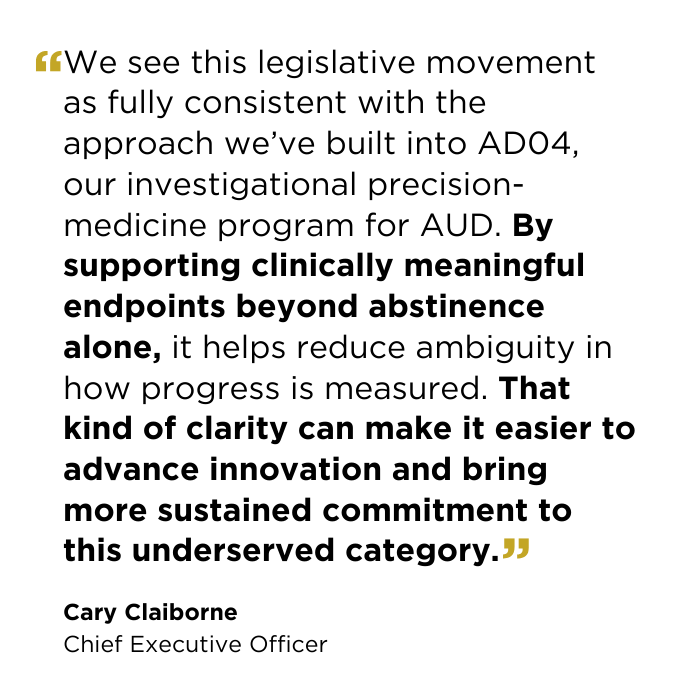
Congress’ directive to the FDA is a tangible sign that policy is catching up to the science by creating clearer expectations for how progress can be measured beyond abstinence alone. For innovators, that means a more workable path to develop therapies and diagnostics that reflect how many patients define success, including endpoints such as reduced cravings, reduced alcohol use, and reduced disorder severity.
This bipartisan commitment also extends to the veterans who have sacrificed for our country. Alcohol misuse has silently ravaged veteran communities, where it is a major driver of substance-related harm. Encouragingly, recent policies acknowledge this reality. The Department of Veterans Affairs has expanded evidence-based AUD treatments, from greater access to medication-assisted therapy to pioneering a pharmacogenomic program (PHASER) that uses veterans’ genetic profiles to guide medication selection and management (including for mental health).[7] Crucially, many of these efforts recognize that veterans’ healing often begins with reducing and stabilizing alcohol use, rather than demanding immediate, total abstinence. By embracing this more realistic, harm-reduction approach, Congress and the Administration are helping fulfill our promise to care for those who served. This focus not only saves lives but also honors veterans with the proactive support they deserve.
Clearing Roadblocks for New Treatments
This directive strengthens and clarifies the pathway for emerging therapies, such as AD04, a non-abstinence-based AUD treatment candidate. For years, the regulatory pathway for new AUD therapies was challenged with roadblocks, such as a lack of patient-first clinical trial endpoints. These constraints have kept larger pharmaceutical companies from entering this space, while also limiting partnership and growth opportunities for the few companies that are currently active in this space. Given Congress’ direction on alternative clinical trial endpoints, the FDA’s approach to these challenges stands to change in the coming months and years.
For Adial, this is more than a procedural tweak; it’s an enabler and validator of our strategy. Our lead candidate, AD04, is being developed as an investigational non-abstinence, genotype-guided therapy for heavy drinking patients identified through a proprietary genetic test. A regulatory environment that explicitly supports non-abstinence endpoints and precision approaches doesn’t just clarify the path forward; it creates a roadmap for an entire new class of AUD treatments. That is how friction turns into stories of success: for patients, for innovators, and for the healthcare system that serves them.
From A Policy Shift to Lasting Impact
It’s heartening to see both Congress and the Administration united in advancing new solutions for AUD. After years of stagnation, we are witnessing a turning point where scientific innovation, patient advocacy, and political will are converging. The FY 2026 report supporting alternative clinical trial endpoints beyond abstinence and the Administration’s high-level focus on addiction recovery together create an environment where novel treatments can thrive. This means hope for millions of Americans and their families who have been waiting for better options.
What’s needed now is sustained action and follow-through. I urge our lawmakers to keep funding and modernizing access to AUD care, so that treatment is available where people live and work. I encourage industry peers and investors to lean into this moment by backing harm-reduction and precision-medicine approaches, including genetic diagnostics that can help match the right therapy to the right patient. And to healthcare providers and advocates, I would simply say: put these tools to work on the front lines, so that the legislative progress in Washington becomes tangible relief in clinics, communities, and VA facilities. If we keep this multi-sector progress going, we can build toward a future where AUD is far less prevalent and far less devastating than it is today.
[1] NIAAA.gov, “Alcohol Use Disorder (AUD) in the United States: Age Groups and Demographic Characteristics,” August 2025
[2] NSDUH/NIAAA.org, 2023 National Survey on Drug Use and Health, Updated August 2025
[3] Rand.org, “Alcohol Use Disorder Among U.S. Veterans,” June 2025
[4] U.S. Centers for Disease Control and Prevention, Morbidity and Mortality Weekly Report, “Deaths from Excessive Alcohol Use — United States, 2016–2021,” 2024
[5] U.S. Centers for Disease Control and Prevention, “Data on Excessive Alcohol Use,” 2024
[6] U.S. Department of Health and Human Services, “Kennedy, Rollins Unveil Historic Reset of U.S. Nutrition Policy, Put Real Food Back at Center of Health,” January 2026
[7] Federal Practitioner, “Improved Pharmacogenomic Testing Process for Veterans in Outpatient Settings by Clinical Pharmacist Practitioners,” May 2025